




Quick answer: Melamine foam and polyurethane foam do different jobs, so they rarely compete for the same position on a product line. Melamine is a rigid, open-cell resin foam that behaves like a very fine abrasive: it erases marks instead of soaking up liquid. Polyurethane (PU) is a soft, elastic foam that holds water, releases it when squeezed and survives thousands of compression cycles. Most successful OEM programs we run use both – PU for the soft body and the absorption, melamine for the erasing face.
How the Two Foams Are Made
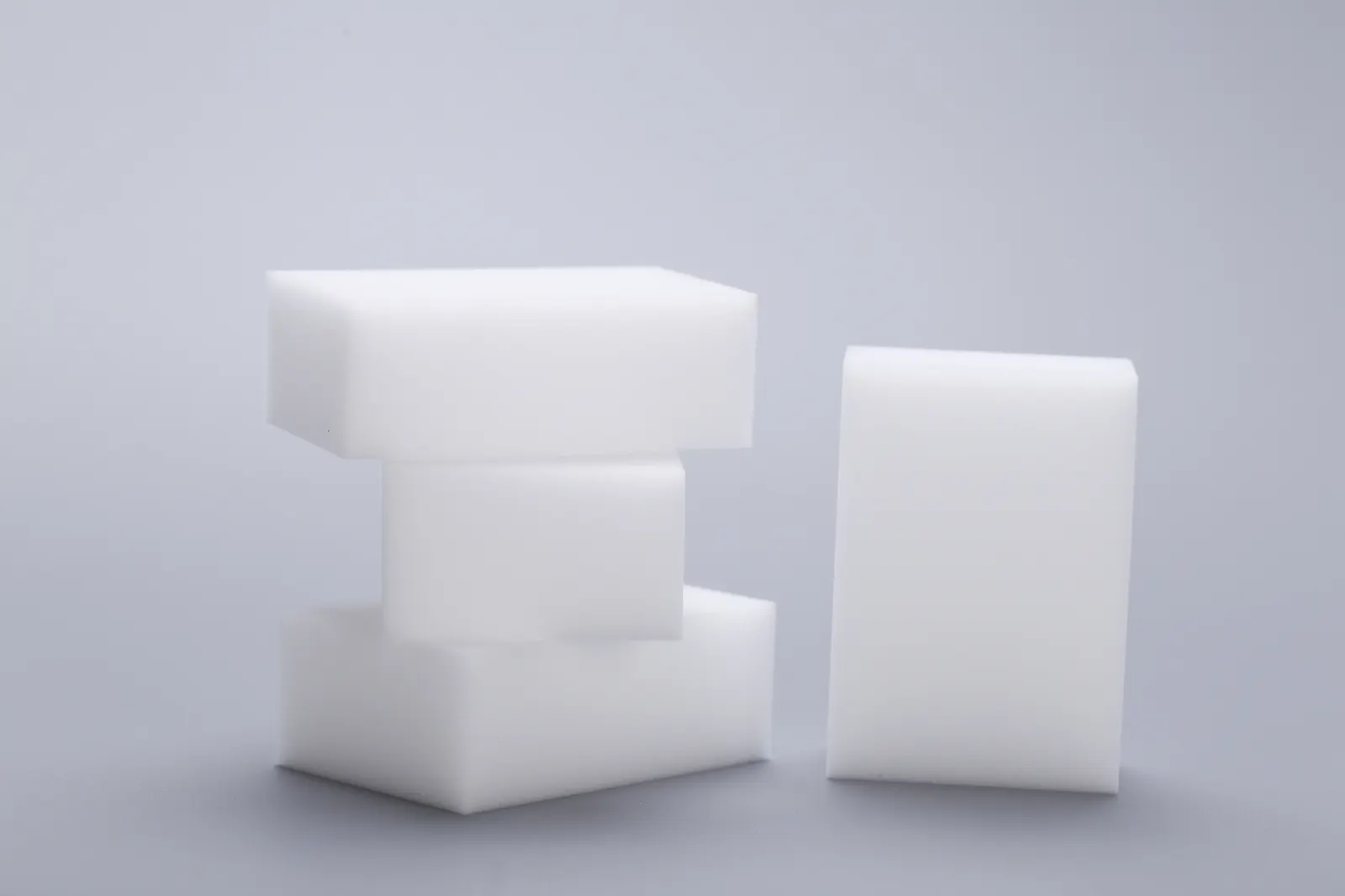
Melamine foam begins as a melamine-formaldehyde resin that is foamed and cured into a block. The result is rigid and open-celled, and the cell walls are thin and slightly brittle – press a fingernail in and they shear off. That brittleness is the product, not a defect. The foam is a consumable abrasive, which is exactly why it crumbles as it lifts marks off a wall.
Polyurethane foam runs on different chemistry. Polyols react with isocyanates into an elastic skeleton, so the cell walls stretch and recover instead of shearing. The foam carries water and detergent to the surface, then lets go of it when you squeeze. It does not erase anything on its own.
Side-by-Side Comparison
| Property | Melamine foam | Polyurethane (PU) foam |
|---|---|---|
| Raw material | Melamine-formaldehyde resin | Polyol reacted with isocyanate |
| Cell structure | Open cell, rigid thin walls | Open cell, elastic walls |
| How it cleans | Micro-abrasion: the foam wears away as it works | Absorption and release: it carries water and detergent |
| Water behaviour | Holds water in the cell network; our grades absorb 750%-2000% of their own weight | Fast uptake, fast release on squeezing |
| Best job | Scuffs, heel marks, grease film, soap scum, hard surfaces | Dishwashing, wiping, sponge bodies, composite scrubber cores |
| Density range we supply | 8-16 kg/m3, selectable per SKU | Quoted with the composite partner line for each SKU |
| Detergent needed | No – water only | Yes, that is the point of a soft body |
| Compliance documents | OEKO-TEX Standard 100 (Class II and IV), EU REACH SVHC 247 screened, FDA 21 CFR 177 | Depends on the foam grade and supplier |
| Freight behaviour | Compressible; vacuum compression cuts CBM sharply | Compressible, recovers on opening |
| Typical end of life | Crumbles to nothing after heavy use | Loses rebound and starts holding odour |
Where Melamine Earns Its Place
- Marks that should come off with water alone: scuffs on painted walls and skirting boards, heel marks on vinyl and ceramic, grease film on range hoods and splashbacks, tea staining inside mugs.
- Water-only cleaning programs: hospitals, hotels, schools and food service sites that are trying to cut chemical usage in guest-facing areas.
- Retail eraser programs: here the block is the product. Density decides how long it lasts, which is the only thing a repeat buyer really notices.
Where Polyurethane Earns Its Place
- Dishwashing bodies: soft enough for coated pans and glassware, and it holds soapy water where the hand needs it.
- Composite scrubbers: a PU body bonded to a non-woven or emery face gives one tool that both wipes and scrubs.
- Volume economics: the soft body is the cheaper half of a two-layer sponge, which is why most laminated kitchen sponges are built that way.
The Cost Question, Without the Marketing
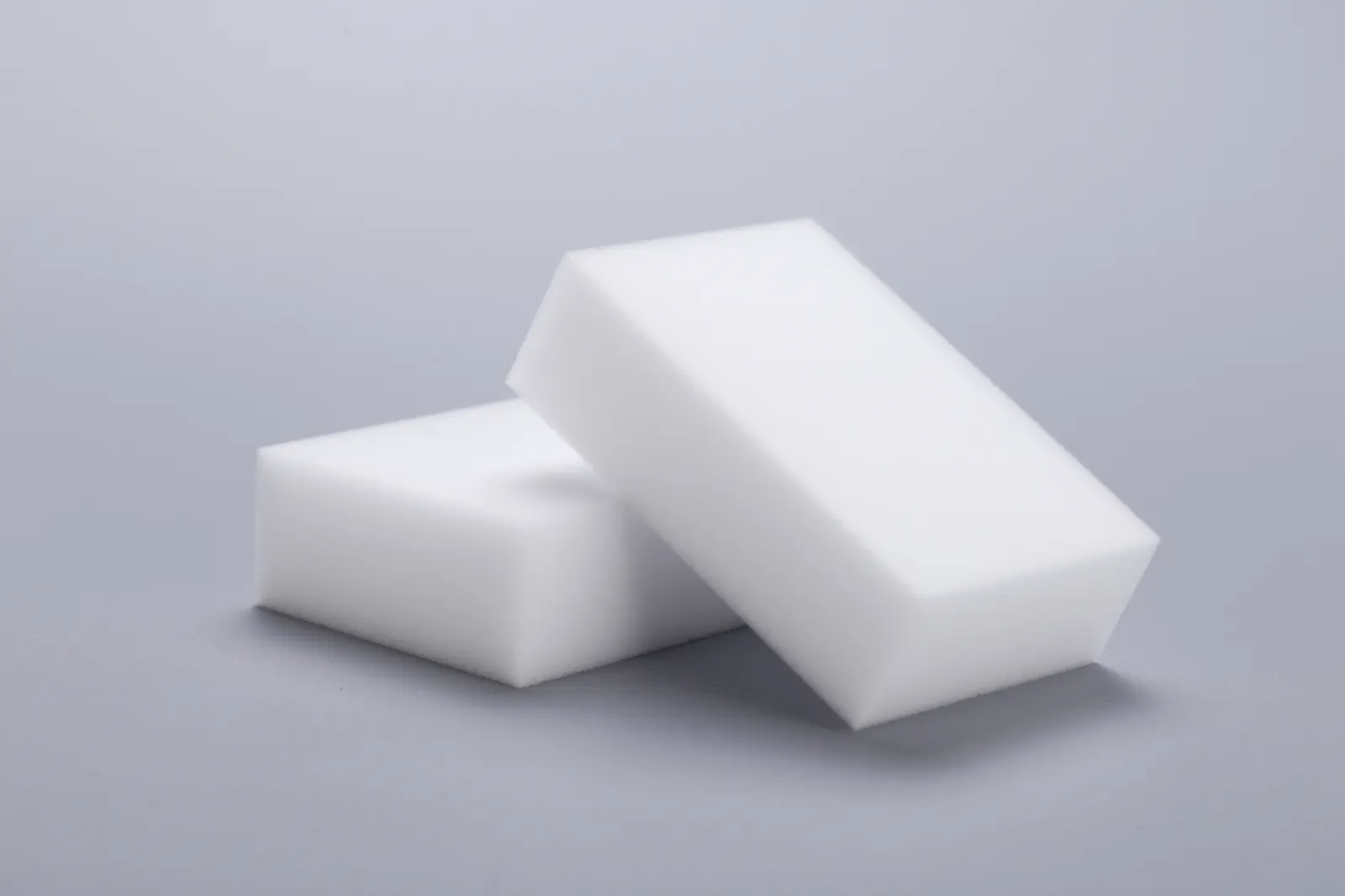
Density is the cost driver in melamine. Two blocks cut to the same dimensions at 8 kg/m3 and 16 kg/m3 do not contain the same amount of resin, and the denser block costs more per piece. That figure on its own tells a buyer nothing about whether the program is cheaper.
What matters is cost per cleaning session. Retail-grade blocks typically run 8-10 kg/m3. Our production range is 8-16 kg/m3, and buyers who move commercial cleaning crews from retail blocks to 16 kg/m3 report roughly twice the usable life before the block crumbles away. If the unit price rises by less than the life extension, cost per session falls. Test that on your own surfaces before committing a container – our sample kits ship with two densities side by side for exactly this reason.
What Buyers Usually Order
Mixed programs are the norm. A retailer might carry a 16 kg/m3 nano eraser block for walls and a laminated PU scrubber for the sink; a hotel group might take melamine erasers for bathroom fixtures and PU-bodied scourers for back-of-house pots. One container, two materials, one set of documents.
For Distributors: What We Manufacture
FoamTech foams its own melamine blocks and converts them into high-density nano sponge erasers, melamine cleaner blocks and die-cut sheets, and supplies PU-bodied kitchen sponges with a scouring face for the soft half of the line. Full ranges sit on the wholesale melamine sponge page and the product catalogue. If you are still deciding which density to buy, the raw material and density guide walks through the trade-offs.
Sample kits take 3 days and production runs 15-20 days for full containers, FOB Ningbo or Shanghai.
Planning a Two-Material Sponge Line?
FoamTech supplies melamine eraser blocks in 8-16 kg/m3 and PU-bodied composite sponges, with OEKO-TEX and REACH documentation per batch. Ask for the sample kit and price list.